
CBD Topicals for Muscle Recovery: A 2026 Guide
Table of Contents
- How CBD Topicals for Muscle Recovery Work
- Key Ingredients to Look for in a Muscle Cream
- How to Use CBD Cream for Muscle Pain
- How Often to Apply CBD Cream
- Full-Spectrum vs. Broad-Spectrum vs. Isolate
- Uncle Milo's CBD Topicals for Muscle Recovery
- Safety and Side Effects of CBD Topicals
- Frequently Asked Questions
Last Updated: September 16, 2026
How CBD Topicals for Muscle Recovery Work
CBD topicals for muscle recovery are cannabinoid-infused creams, gels, and balms applied directly to the skin to soothe sore, tired muscles. This guide breaks down how they work, which ingredients matter, and how to apply them.
Skin Absorption and Bioavailability
Bioavailability is the share of a compound that reaches the tissue you're targeting. With topicals, that number stays low compared to edibles or tinctures because the skin's outer layer, the stratum corneum, is a barrier first and a delivery system second.
- Topical (local) delivery keeps most of the cannabinoid in the skin and underlying tissue. You feel it where you put it, and very little reaches circulation. This is what almost every muscle cream, gel, and balm on the market actually does.
- Transdermal delivery uses carriers designed to shuttle molecules past the stratum corneum and into the bloodstream for systemic, whole-body effects. True transdermal patches are engineered for this; a scented balm in a jar is not.
What Actually Gets a Cannabinoid Through the Skin
Transdermal absorption depends on molecule size, fat solubility, carrier ingredients, and contact time. Cannabidiol is a relatively large, greasy molecule, so formulators lean on a few strategies:

- Penetration enhancers like menthol, camphor, and certain terpenes temporarily loosen the lipid packing in the stratum corneum so more of the formula moves through.
- Occlusive carriers such as shea butter, cocoa butter, and jojoba oil slow water loss and keep the active ingredients in contact with skin longer instead of evaporating or rubbing off.
- Humectants like aloe and glycerin pull water into the upper skin layers, which can improve how comfortably a formula spreads and how long it stays put.
Why This Matters for Muscle Recovery Specifically
Soreness after training is a local problem: microdamage and inflammation in a specific muscle group. That makes topicals a reasonable fit, you treat the tissue that hurts, at the site where it hurts, without asking your liver to process anything.
Key Ingredients to Look for in a Muscle Cream
The best muscle creams combine a cannabinoid source with botanicals that do measurable work. Read the label in this order: cooling or warming agents, carrier oils, then supporting plant extracts.
Here's what earns its place in a formula:
- Menthol or camphor for an immediate cooling sensation and a warming effect as it fades
- Lidocaine for temporary relief of minor aches and pains, usually listed at 4%
- Arnica and methyl salicylate for exercise-induced pain and joint stiffness
- Jojoba, aloe, and vitamin E to carry the formula in and keep it non-greasy
- Lavender and rosemary essential oils for muscle tension and a calming scent profile
How to Use CBD Cream for Muscle Pain
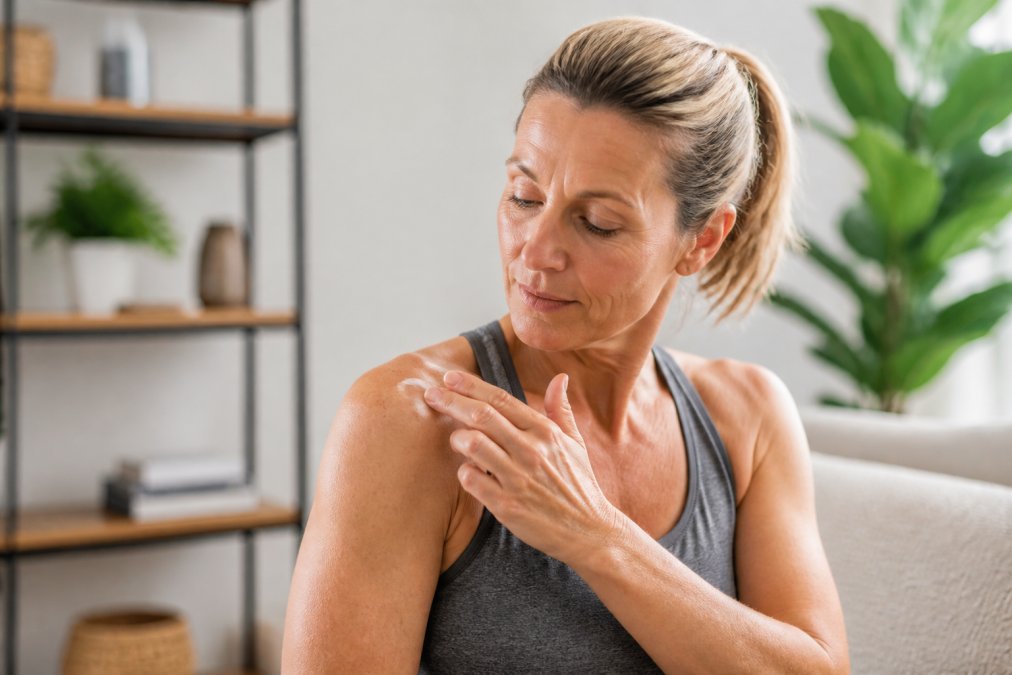
To use CBD cream for muscle pain, apply a thin layer to the affected area, massage it in gently, and wash your hands. Start small and build up, more product does not always mean more relief.
Application Tips for Maximum Relief
A common mistake is rubbing product in like lotion and expecting it to work in five minutes. Here's what helps:
- Clean the area first so the formula isn't sitting on top of sweat or sunscreen
- Use enough to cover the muscle belly, not just the sore spot
- Massage in circular motions for 30 to 60 seconds to boost circulation
- Reapply to the same area no more than three to four times daily
- Wash hands immediately, especially before touching your eyes
How Often to Apply CBD Cream
Most people get the best results applying CBD cream two to three times per day: morning, after activity, and before bed. Spacing matters because cooling agents fade within hours, and reapplying too soon stacks menthol and lidocaine faster than your skin needs.
Where a Topical Fits in a Full Recovery Stack
A muscle cream isn't a standalone fix. It's one layer in a routine that also includes mechanical work, temperature, and compression, and the order changes how each one feels.
A workable sequence for post-training soreness:
- Cool down and rehydrate first. A topical applied to hot, sweaty skin absorbs unevenly. Wait 15 to 20 minutes, rinse if you can, and dry the area.
- Foam roll or do light mobility work before you apply. Mechanical pressure on a muscle that's already coated in menthol or lidocaine is uncomfortable, and the cream can transfer to the roller. Roll first, then apply.
- Apply the topical to the muscle belly. Massage in circular motions for 30 to 60 seconds. This is the step where the product does its job.
- Add compression or cold, with one caveat. A compression sleeve over menthol or methyl salicylate can intensify cooling and cause irritation in some people; test on a small area first. Never combine these ingredients with a heating pad or hot bath over the same area, heat drives absorption up and raises the risk of skin reactions.
- Reapply before bed if soreness is still building. Delayed onset muscle soreness typically peaks a day or two after training, so the overnight application is often the one people notice most.
Pairing Rules Worth Knowing
- Cold exposure and topicals: Use an ice bath or cold pack before applying the cream, not after. Cold numbs the area, so you can't judge how much product you're using or whether it's irritating your skin.
- Compression gear: A sleeve or wrap over a topical is fine for most people, but it traps the formula against skin for longer. If you're prone to redness, skip the wrap on the first few uses.
- Heat-based recovery: Saunas, hot tubs, and heating pads should come before application, never after. Heat plus menthol or methyl salicylate is the combination most likely to cause a reaction.
- Other topicals: Don't stack a CBD cream on top of a menthol rub or an NSAID gel. You're doubling the same active ingredients without any added benefit.
Matching Frequency to Your Training Load
The harder the session, the more the overnight application matters and the less the mid-day one does.
- Light or active-recovery days: One application before bed is usually enough.
- Moderate training: Apply after activity and again before sleep.
- Heavy or back-to-back sessions: Add a morning application on the day after, when soreness tends to peak.
- Rest days: Keep the before-bed application if you're still sore; skip the rest.
Full-Spectrum vs. Broad-Spectrum vs. Isolate
The three extract types differ in what they keep from the hemp plant, which shows up in effect and label transparency.
| Extract Type | What It Contains | Best For | Label Check |
|---|---|---|---|
| Full-spectrum | Cannabinoids, terpenes, trace THC | Entourage effect seekers | THC content disclosed |
| Broad-spectrum | Cannabinoids, terpenes, no THC | THC-sensitive users | "ND" on THC lab result |
| Isolate | Cannabidiol only | Minimalist formulas | Purity percentage listed |
Uncle Milo's CBD Topicals for Muscle Recovery
Uncle Milo's is a family-owned, small-batch hemp company. The Uncle Milo's 2000mg CBD Muscle Cream at $39.99 pairs cannabidiol with lavender and rosemary essential oils in a dual-action formula that cools then gently warms. It absorbs quickly without greasy residue.
Safety and Side Effects of CBD Topicals
Topicals are the lowest-risk way to use cannabidiol because bloodstream absorption is minimal. Most side effects are skin-level, redness, itching, or irritation, usually from a carrier oil or fragrance rather than the cannabidiol itself.
Frequently Asked Questions
Is CBD cream good for pulled muscles?
CBD topicals for muscle recovery can help with the discomfort of a pulled muscle. The CBD interacts with cannabinoid receptors in the skin, while ingredients like menthol and arnica add cooling or warming relief. Uncle Milo's 2000mg CBD Muscle Cream combines CBD with lavender and rosemary oils to support post-workout recovery. Apply it to the affected area two to three times daily, and pair it with rest and ice as needed. See a doctor if pain is severe or lasts more than a few days.
How long does it take for CBD cream to start working on muscle pain?
Most people notice a cooling or warming sensation within 10 to 20 minutes of applying CBD topicals. The CBD itself may take longer to interact with cannabinoid receptors in the skin, so full localized relief can build over 30 to 60 minutes. Factors like absorption rate, potency in milligrams per ounce, and how much you massage the cream in all affect timing. Uncle Milo's CBD Muscle Roll-On Cooling Gel delivers menthol and lidocaine for faster onset, while the 2000mg CBD Muscle Cream works gradually for longer-lasting comfort.
Are there side effects to using CBD topicals for muscle soreness?
CBD topicals are generally well tolerated because they act locally rather than entering the bloodstream in large amounts. Some people with sensitive skin may notice mild redness or irritation, especially with menthol or lidocaine formulas. Do a small patch test on your inner arm before applying broadly. Uncle Milo's products are made without parabens, sulfates, or artificial dyes, which reduces the chance of skin reactions. If irritation persists, stop use and consult a healthcare provider.
Do you need a prescription to get CBD cream?
No prescription is needed for hemp-derived CBD topicals in the United States, as long as the product contains no more than 0.3% THC under the 2018 Farm Bill. You must be at least 21 years old to purchase Uncle Milo's products. Some states restrict certain hemp products, so check your local rules. Uncle Milo's bath bombs, for example, do not ship to California or Idaho. Always buy from brands that publish third-party lab results and a certificate of analysis so you know exactly what is in the jar.
Muscle soreness rarely resolves on a schedule you choose, and the recovery products crowding the shelf don't make the decision easier. Uncle Milo's keeps it simple: small-batch formulas, published lab results, and topicals built for targeted relief. Start with the 2000mg CBD Muscle Cream for everyday soreness, add the roll-on for hard-to-reach spots, or bundle both with the Bath and Body Box for a full recovery routine. Shop by product and find the format that fits how you move.